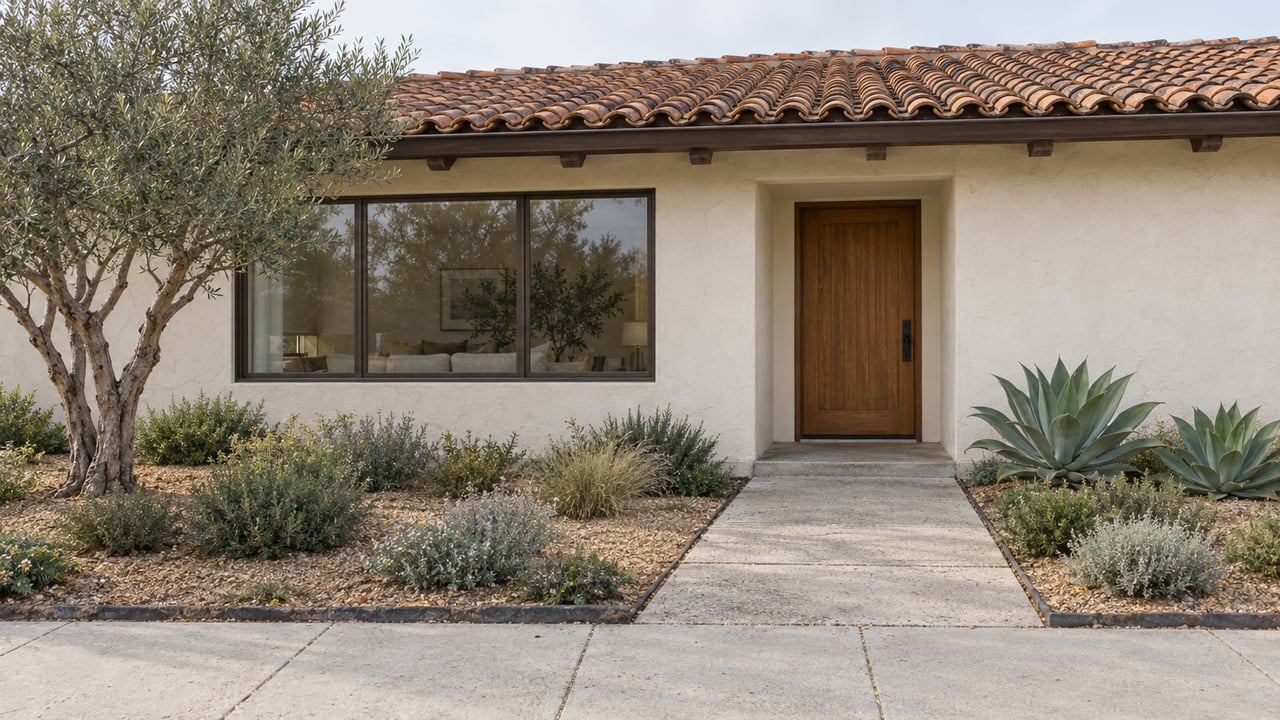
Two Carlsbad houses can carry the exact same list price and still qualify a buyer for two different loan amounts. Not because of the home. Because of an address.
Run a pre-approval on a home in Olde Carlsbad and a home in Robertson Ranch at the same price point and the lender's math changes before you get to the interest rate. One of those addresses carries a Mello-Roos special tax. The other doesn't. Lenders count that special tax as recurring housing debt in the same column as your mortgage payment, your base property tax, and your HOA dues, so it shows up directly in your debt-to-income ratio and can shrink the loan amount you qualify for. A list price treats both homes as equivalent. A loan officer does not.
Why the Same Price Doesn't Mean the Same Payment
Mello-Roos is a special tax tied to a Community Facilities District, created under a 1982 state law that let cities finance streets, schools, and parks in new developments after Proposition 13 capped how much they could raise through ordinary property taxes. The tax isn't based on what your home is worth. It's set by a formula written into the district's formation documents, and it rides along with the parcel for as long as the bonds are outstanding, typically 20 to 40 years depending on the district.
Here's the part that matters for comparison shopping: it's parcel-specific, not neighborhood-specific in any simple way, and it stacks on top of the base property tax rate of roughly 1.1% to 1.2% that applies statewide under Proposition 13. A 2026 analysis of Carlsbad carrying costs put the swing between comparable properties, one with Mello-Roos and one without, at $300 to $600 a month once HOA dues and special assessments are added up. That's not a rounding error on a mortgage payment. It's often the difference between qualifying for the home you want and qualifying for the one down the street.
Where the Line Actually Falls
Carlsbad isn't one market with one tax profile. It splits along development era, and the split maps almost exactly onto the city's four zip codes.
| Zip Code | Character | Typical Mello-Roos Status | Named Areas |
|---|---|---|---|
| 92008 | Village, Olde Carlsbad, The Barrio | Generally none | Carlsbad Village, Olde Carlsbad, The Barrio |
| 92009 | La Costa, split old and new | Mixed, exception inside | Old La Costa (none), La Costa Greens, La Costa Ridge, La Costa Oaks, La Costa Valley (Mello-Roos applies) |
| 92010 | Newer master-planned | Common | Bressi Ranch, Calavera Hills, Robertson Ranch, The Foothills at Carlsbad |
| 92011 | Resort and golf corridor | Applies broadly | Aviara |
Olde Carlsbad and Carlsbad Village predate the master-planned era entirely. Most single-family homes there carry no HOA and no Mello-Roos, since the infrastructure was already in place before Community Facilities Districts existed as a financing tool. Olde Carlsbad's median sale price has run around $1.7 million to $1.75 million through 2026, with condos offering a lower entry point and larger or ocean-view estates pushing well past $2.5 million. Carlsbad Village runs a similar range for single-family homes, with recent medians closer to $1.9 million to $2 million, and its older cottages and small-lot houses carry the same tax-free profile.
Robertson Ranch tells the opposite story. It's Toll Brothers-built and split into four named villages, The Bluffs, The Ridge, The Vistas, and The Terraces, and its combined effective tax rate including base property tax and Mello-Roos typically lands in the 1.2% to 1.4% range, versus the 1.1% to 1.2% baseline in older Carlsbad neighborhoods without a district. Because Mello-Roos is set at the parcel and phase level rather than uniformly across a community, a home in one Robertson Ranch village can carry a different remaining bond term than one a few streets away in another. The same logic applies at Bressi Ranch, Calavera Hills, and The Foothills, all financed in part through CFDs that paid for the roads, parks, and in some cases the schools, including Sage Creek High, that serve those neighborhoods today.
Aviara, in 92011, has no way around it. Every property there sits under the Aviara Master Association, with HOA dues in the $200 to $500-plus monthly range, and Mello-Roos applies broadly across the community. There's no HOA-free lane the way there is elsewhere in the city.
The Exception Inside La Costa
La Costa is where the assumption that "newer equals Mello-Roos" breaks down. The area covers everything from golf-course estates to fully built master-planned tracts, and 92009 is the one Carlsbad zip code where a genuinely tax-free option still exists inside a resort-adjacent price band: Old La Costa. Custom estates there start around $1.5 million and climb with hillside and ocean-view positions, and unlike La Costa Greens, La Costa Ridge, La Costa Oaks, or La Costa Valley next door, Old La Costa carries no HOA and no Mello-Roos.
That's a meaningful distinction for a buyer comparing two homes both labeled "La Costa" on a portal listing, because the label doesn't tell you which side of that line you're on. School assignment adds another layer of the same problem. Properties in 92009 can fall under Carlsbad Unified, San Dieguito Union, or San Marcos Unified depending on the exact address, and La Costa Valley specifically sits in San Dieguito territory. Rancho Carrillo carries a Carlsbad mailing address but is served by San Marcos Unified, not Carlsbad Unified, which catches buyers off guard when they assume a Carlsbad address means Carlsbad schools. None of this shows up in a headline price. All of it shows up in escrow.
What to Ask Before You Write an Offer
The fix isn't complicated, but it has to happen before the offer, not after the inspection.
- Request the Notice of Special Tax for the specific parcel. California law requires sellers to make a good-faith effort to disclose Mello-Roos through this form and the Transfer Disclosure Statement, and it will spell out the current rate, the maximum allowed increase, and any escalator clause.
- Ask how many years remain on the bond. A district five years from payoff behaves very differently than one with three decades left, and the county's current list of active Mello-Roos districts for the fiscal year is public.
- Tell your lender the exact dollar figure early, not during underwriting. Mello-Roos gets folded into your housing expense ratio the same way HOA dues do, and finding out late can change the loan amount you're approved for.
- Compare total monthly carrying cost, not list price, when two homes in different Carlsbad neighborhoods are otherwise similar. A less expensive house on paper can cost more every month once the special tax and HOA are added in.
A Few Questions Buyers Ask
Does Mello-Roos ever go away? Yes, once the underlying bonds are retired. Terms run 20 to 40 years by law, and some districts formed in the late 1990s and early 2000s are closer to that finish line than buyers assume, though a few districts keep a smaller ongoing charge for maintenance after the bond itself is paid off.
Is it tax deductible? No, not the way mortgage interest is. Mello-Roos is a special tax assessment, not an ad valorem property tax, and it doesn't qualify for the same federal deduction treatment.
Does every home in La Costa have it? No. Old La Costa is the specific, named exception within 92009. The newer sections built as La Costa Greens, La Costa Ridge, La Costa Oaks, and La Costa Valley do carry it. The label "La Costa" alone won't tell you which is which.
Comparing two Carlsbad neighborhoods on price alone answers half the question. The other half lives on the tax bill, and it's worth pulling before you fall in love with either house. Edwards Homes Team can run the full carrying-cost comparison side by side, Mello-Roos, HOA, and base tax included, so you know exactly what a home actually costs before you write the offer.